With the US 10-year yield near 5%, a common question on FX desks and allocation committees is which currency exposures a further jump in yields would hurt. The standard answer, emerging markets, is half right. The decision is which exposures to hedge against a rate shock and which to hedge against a risk-off shock, because they are not the same currencies.
I tested it on weekly spot rates for 24 currencies against the dollar from April 2004 to October 2026, alongside the weekly change in the US 10-year Treasury yield and the S&P 500.
Executive summary
The question. Which currencies fall against the dollar when US yields rise sharply, and does it depend on whether stocks fall at the same time?
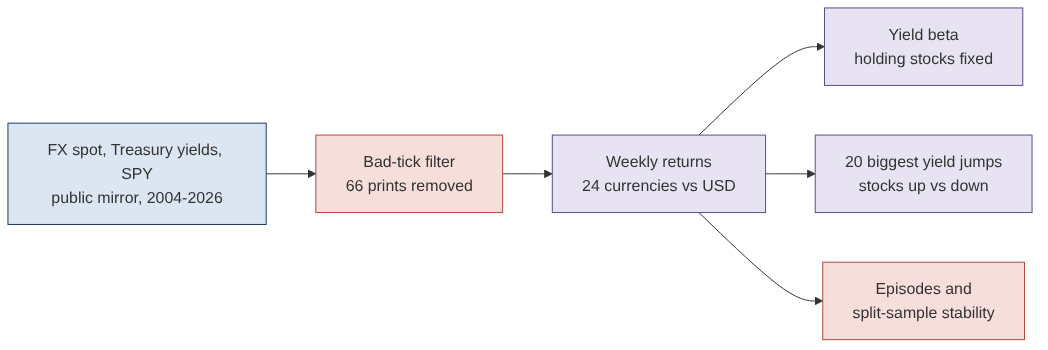
The approach. 1,179 weeks of spot rates for 15 emerging and 9 developed currencies, cleaned of bad prints. Each currency was regressed on the weekly change in the 10-year yield and the S&P 500 return together. The 20 biggest weekly yield jumps were split by whether stocks fell, three yield-shock episodes were replayed, and the ranking was checked for stability across 2004–2015 and 2016–2026.
The answer. Holding stocks fixed, the yen is by far the most rate-sensitive currency: −4.6% per 100 bp, followed by the Swiss franc (−2.3%) and the euro (−1.5%). Emerging currencies' direct sensitivity is small; their losses come when a yield jump arrives with falling stocks. In those weeks the rand, New Zealand dollar, Chilean and Mexican pesos fell about 2% on average, while in yield jumps with rising stocks most currencies gained. The yen fell in both.
The decision. Stress currency exposures against two different yield shocks, one with stocks falling and one with stocks rising, and treat yen and franc exposure as rate risk, not just as safe-haven risk.
Business outcomes
| Decision | What the data showed | What it means |
|---|---|---|
| Treat the yen as a safe haven only | −4.6% per +100 bp holding stocks fixed (t = −11.1); fell in yield jumps whether stocks rose or fell | Yen exposure is a large, persistent short-rates bet |
| Hedge emerging FX against rate shocks | Real +0.04%, lira −0.3%, rupee −0.35% per 100 bp once stocks are held fixed | The rate hedge alone misses the real driver |
| Hedge emerging FX against risk-off | In yield jumps with stocks falling: rand −2.1%, Chilean peso −1.95%, Mexican peso −1.8% a week | The losses arrive when yields and stocks move against you together |
| Assume betas are stable | Rank correlation 0.56 between 2004–2015 and 2016–2026; median sensitivity −0.8% → −1.4% per 100 bp | Ranking is usable; magnitudes have grown |
| Size a $100M unhedged yen position | About −$4.6M of dollar value per +100 bp in the 10-year yield, holding stocks fixed | A rate scenario belongs in the FX line |
Weekly spot returns against the dollar, April 2004 to October 2026. Betas from a regression on the weekly 10-year yield change (bp) and the S&P 500 return, with Newey-West t-statistics. Spot only: interest carry is not included. Dollar figures are illustrative.
End to end in five steps
| Step | What happens | Output |
|---|---|---|
| 1. Source | Daily spot rates for 24 currencies per US dollar, US Treasury yields, SPY | Checksum-pinned public data |
| 2. Clean | Centred rolling-median filter removes isolated bad prints and keeps genuine devaluations | 66 prints removed across 16 currencies |
| 3. Betas | Weekly currency return on the 10-year yield change and the S&P 500, Newey-West t-statistics | Rate sensitivity holding stocks fixed |
| 4. Shocks and episodes | The 20 biggest weekly yield jumps split by stocks up or down; taper tantrum, 2022, late 2024 | What happened when it mattered |
| 5. Stability | Betas re-estimated for 2004–2015 and 2016–2026; rank correlation | Is the ranking reliable? |
The data
Daily spot closes from the public defeatbeta Yahoo Finance mirror on Hugging Face (ODC-BY), quoted as units of each currency per US dollar, pinned by checksum. Emerging: Brazil, Mexico, Chile, Colombia, Peru, South Africa, Turkey, India, Indonesia, Korea, the Philippines, Thailand, Malaysia, Taiwan and China. Developed: euro, yen, pound, Swiss franc, Canadian, Australian and New Zealand dollars, Norwegian and Swedish krone. Pegged currencies are excluded. Yahoo FX history contains occasional misplaced decimals; a filter that compares each print with a centred 11-day median removed 66 of them, mostly in the Colombian peso and the rupiah, while leaving genuine jumps such as the Swiss franc's January 2015 move in place. Returns are spot only; the interest carry earned by holding a higher-yielding currency is not included.
The results
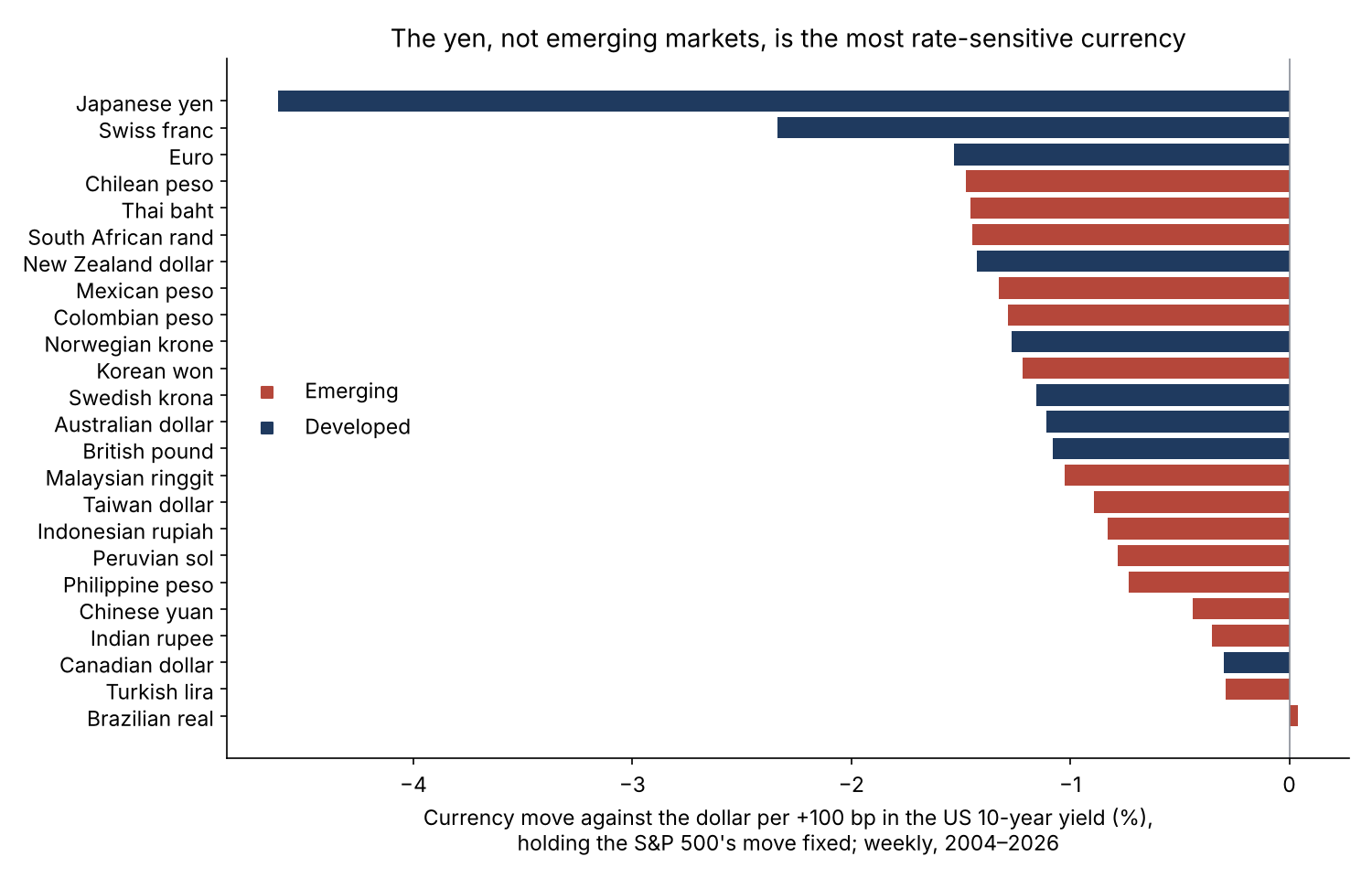
Nearly every currency weakens against the dollar when US yields rise, but the size differs by a factor of a hundred. The yen's −4.6% per 100 bp is twice the next currency's. The funding currencies, the yen, franc and euro, carry the largest pure rate sensitivity because their own yields stay anchored while US yields move. Emerging currencies sit lower on the chart because, once the stock market's move is held fixed, much of their sensitivity disappears: the Mexican peso, rand and Australian dollar carry S&P 500 betas of 0.3 to 0.4.
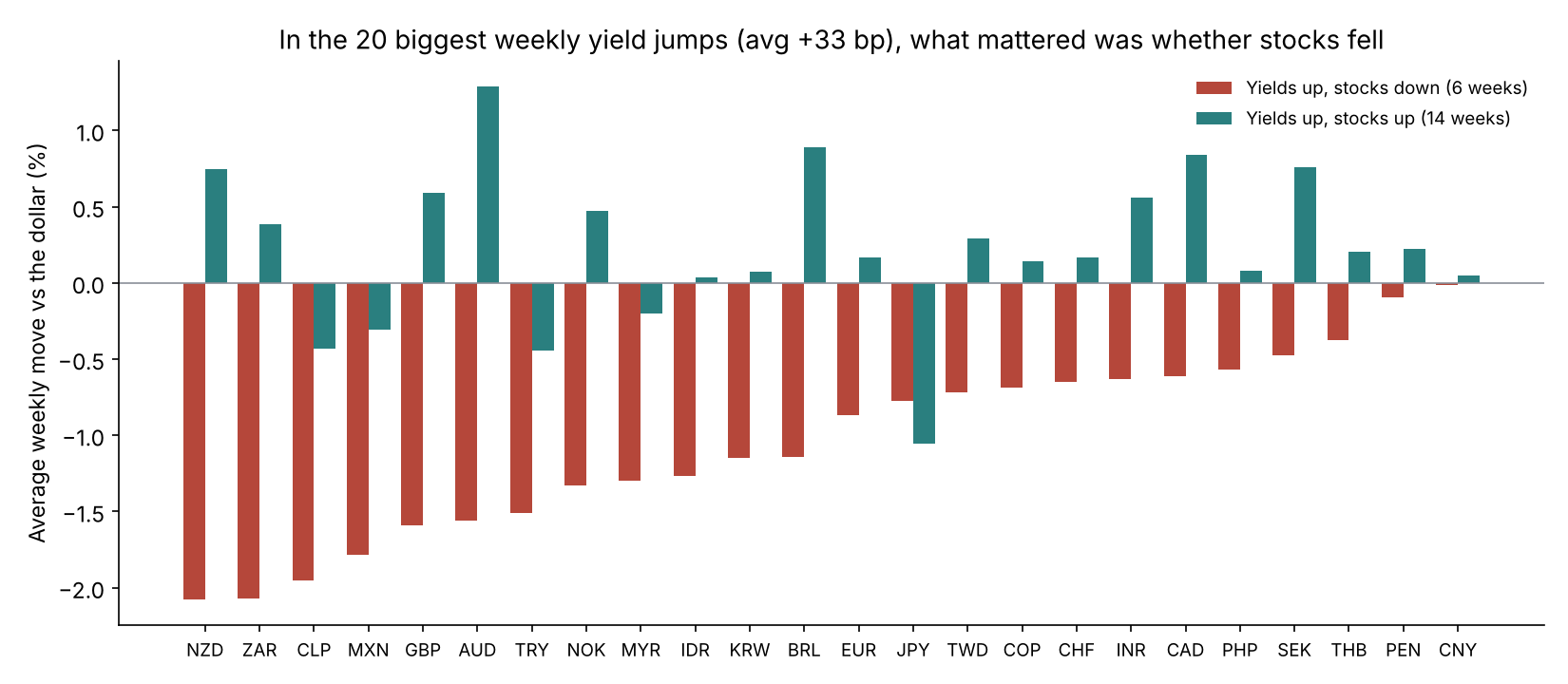
The biggest yield jumps came in two kinds. In 14 of the 20, stocks rose too, usually on stronger growth, and most currencies gained against the dollar. In the other 6, including June 2013, April 2022 and October 2023, stocks fell, and the high-beta currencies lost about 2% in a week: New Zealand dollar −2.1%, rand −2.1%, Chilean peso −1.95%, Mexican peso −1.8%, lira −1.5%. The yen fell in both kinds of week.
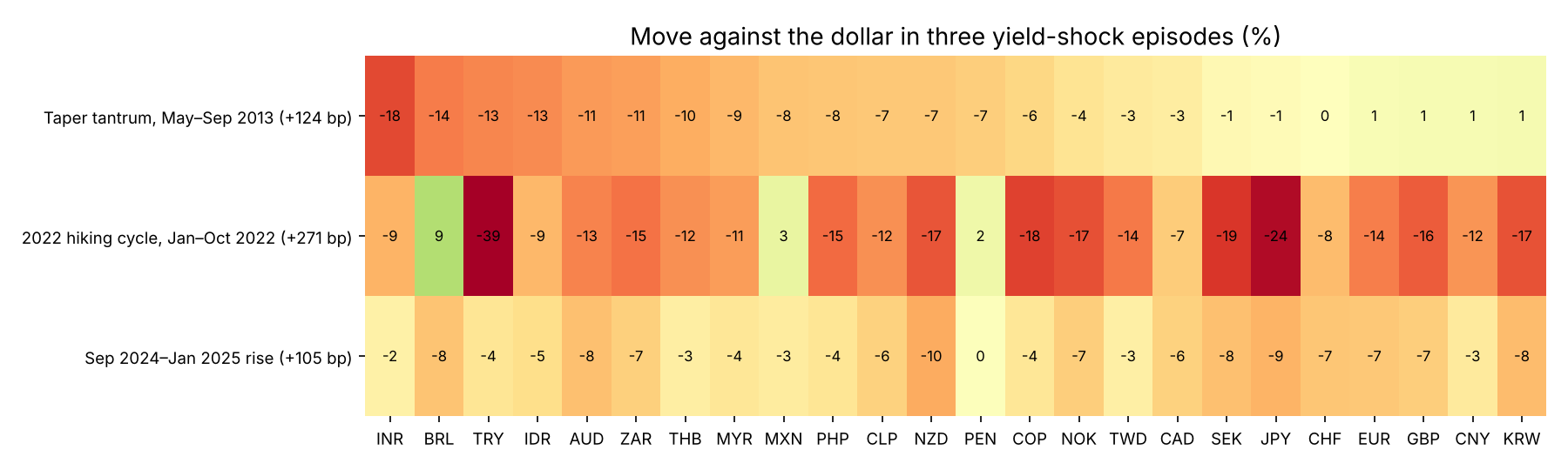
The episodes tell the same story at a longer horizon. In the 2013 taper tantrum, a growth-scare shock, the currencies with large external financing needs fell hardest: rupee −17.9%, real −13.8%, lira −13.0%, rupiah −12.7%, rand −11.0%, while the euro and pound rose about 1%. In 2022, an inflation and policy shock, the yen fell 23.8% and the lira 38.6%, but the real rose 8.7% and the Mexican peso 2.9%, with their own central banks hiking early.
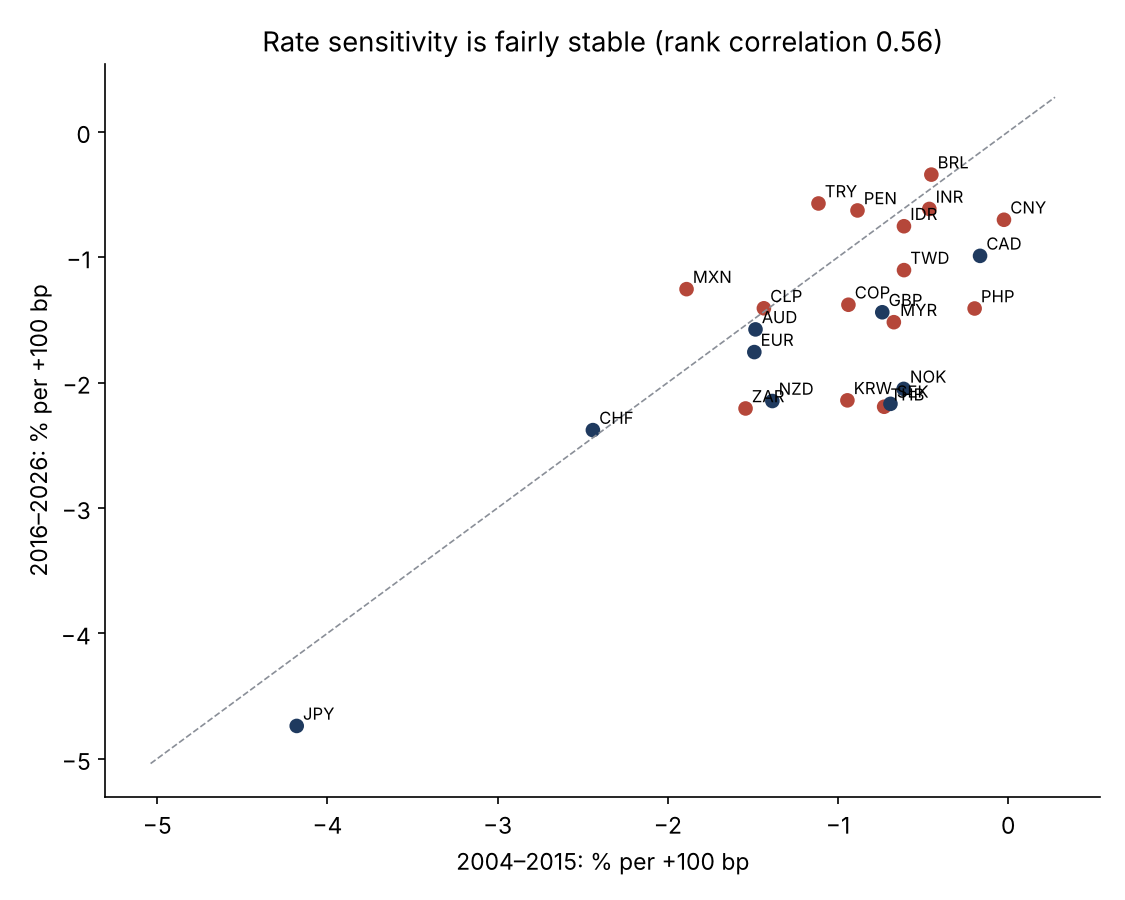
The ranking is fairly stable: the rank correlation between the two halves is 0.56 (p = 0.004), with the yen most sensitive in both. Magnitudes grew: the median currency's sensitivity moved from −0.8% to −1.4% per 100 bp, and 18 of 24 became more rate-sensitive after 2015.
Recommendations
- Decision: stress currency exposures against two yield shocks, one with stocks falling and one with stocks rising, and hedge each exposure against the shock it is actually sensitive to.
- Classification: treat yen and Swiss franc exposure as rate risk as well as safe-haven risk in the hedge policy.
- Emerging FX: pair rate scenarios with equity drawdown scenarios; the losses cluster when both move together.
- Monitoring: re-estimate betas quarterly; sensitivities have risen since 2015.
- Carry: evaluate any unhedged high-yielding currency on spot plus carry, which this study does not include.
Limits
- Spot returns only; interest carry, which matters most for high-yielding currencies, is excluded.
- Weekly data and one US rate; local rates and policy are not modelled.
- Yahoo FX prices required cleaning; some residual errors may remain.
- Twenty shock weeks is a small sample; six with stocks falling is smaller still.
- Independent research on public data. Not deployed; not investment advice.
How it was built
Sources
Data
- FX spot, US Treasury par yields and SPY prices: defeatbeta, "yahoo-finance-data", huggingface.co/datasets/defeatbeta/yahoo-finance-data, ODC-BY; files
exchange_rate,daily_treasury_yieldandstock_prices, downloaded 7 November 2026 and pinned by sha256.
Methods referenced
- Eichengreen, B. and Gupta, P. (2015). "Tapering Talk: The Impact of Expectations of Reduced Federal Reserve Security Purchases on Emerging Markets." Emerging Markets Review 25, 1–15.
- Newey, W. K. and West, K. D. (1987). "A Simple, Positive Semi-definite, Heteroskedasticity and Autocorrelation Consistent Covariance Matrix." Econometrica 55(3), 703–708.
Code & downloads
Independent research on public data, not investment advice; dollar figures are illustrative. Analysis, code, charts and text were produced with AI assistance and reviewed by the author.